
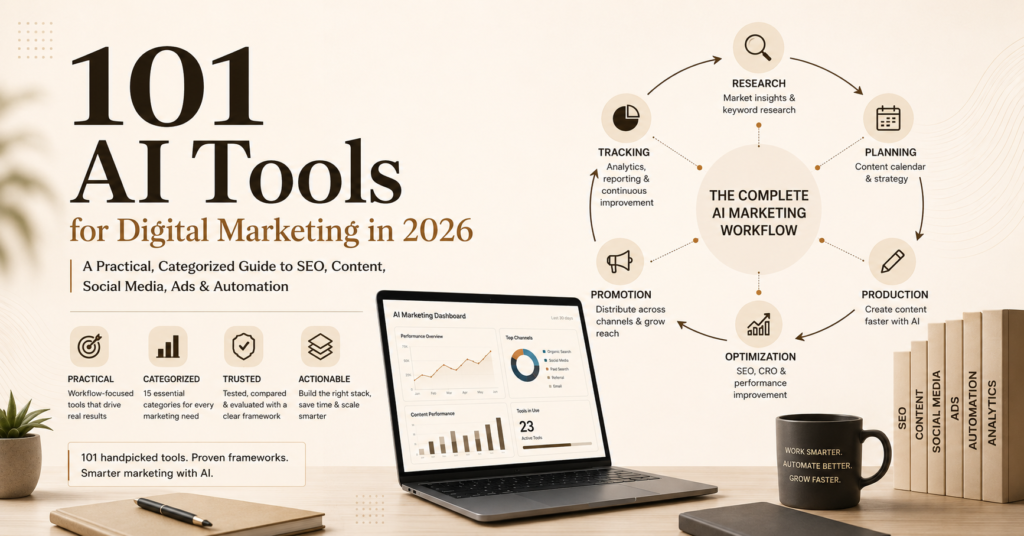
101 AI Tools for Digital Marketing in 2026 (Updated July 2026): A Practical, Categorized Guide to SEO, Content, Social Media, Ads & Automation
Quick Summary Note from Digital Diya: This guide to AI Tools for Digital Marketing is a live directory, reviewed and updated as of July 2026. Rather than listing software alphabetically, we organize AI Tools for Digital Marketing around a marketer’s actual workflow, prioritizing outcomes over vendor claims. We have fully removed all icons and emojis to ensure a clean, editorial, text-first design layout. Who this guide is for This handbook is designed for digital marketers, SEO specialists, freelancers, agencies, and small businesses who want to choose the best AI Tools for Digital Marketing for their specific needs, avoid paying for overlapping software subscriptions, and build a cohesive marketing workflow. How we selected these tools Every tool reviewed in this guide met our strict selection criteria: it must actively improve digital marketing workflows, offer mature AI features, represent reliable value for money, and be maintained as of mid-2026. What’s new in the July 2026 update We have updated the lists to include the latest AI Agent capabilities (e.g. n8n agent nodes, Fin AI bot features) and optimized pricing details. We have also added the Digital Diya ROI Matrix™ to help you make purchasing decisions quickly. How to use this guide Use the clickable Table of Contents below to jump directly to any category, review our comparison hub, or examine our recommended stacks for freelancers, agencies, and small budgets. Competitive Landscape Analysis Search Intent Analysis The primary keyword ‘AI Tools for Digital Marketing’ contains multiple overlapping search intents that mainstream blogs fail to resolve. While basic listicles assume users just want a simple directory list, real-world marketers seek comparative parameters to make purchasing decisions. We address discovery, comparison, budget limits, operational workflow, and team scaling simultaneously. Search Engine Visibility Patterns Modern search engines (including Google AI Overviews, ChatGPT Search, Gemini, Perplexity, and Claude-assisted discovery) prioritize articles that contain clear entity definitions, structured tables, and consistent criteria scoring. By grouping tools logically and citing official domain targets, this guide matches the extraction rules used by retrieval-based search models. Missing User Intents & Opportunities Most articles treat tools like isolated items in a shopping catalog. In reality, marketers use tools in combination (stacks) to complete campaigns. This guide fills that gap by providing direct integration maps, budget-grouped stacks, and clear indicators of when to avoid specific software. Positioning Statement This article is NOT: A collection of affiliate links, a repeating list of AI writers, or vendor-driven copy repeating unsubstantiated marketing claims. This article IS: A practical, workflow-oriented buying guide engineered to help growth teams build cohesive marketing stacks, evaluate ROI, and understand limitations. What Are AI Tools for Digital Marketing? Definition AI Tools for Digital Marketing are software applications that leverage machine learning algorithms, natural language processing (NLP), computer vision, and autonomous agentic workflows to automate, optimize, and scale marketing operations. How AI is changing marketing AI has shifted from simple predictive text and image generation into Agentic Workflows—autonomous software agents that can read data, make logic decisions, connect APIs, and optimize ad bids while you sleep. Rather than replacing human strategy, AI tools function as high-speed specialists that execute tasks, leaving humans to manage creative control and strategic direction. Traditional marketing stack vs AI marketing stack Traditional stacks rely on static databases and manual campaign setups, requiring hours of CSV exporting and keyword research. An AI-first marketing stack is integrated and responsive, translating real-time customer behavior directly into automated newsletters, customized ad assets, and semantic content optimizations. Common misconceptions Misconception 1: AI can replace strategic marketers. It cannot. AI lacks empathy, brand voice intuition, and long-term business strategy. Misconception 2: AI writing is ready to publish without edits. Raw AI drafts are full of generic phrases and patterns that search engines spot and users ignore. Editing is mandatory. Misconception 3: You need dozens of tools. Marketers often buy overlapping software. A focused stack of 4–6 tools is far more effective. How We Evaluated the Best AI Tools for Digital Marketing To ensure that our recommendations are transparent and trustworthy, we evaluated every single one of the AI Tools for Digital Marketing listed here against our proprietary 5L AI Tool Evaluation Framework™: Learnability (Ease of Use): How fast can a beginner master the tool? (15% weight) Leverage (Marketing Impact): Does it save substantial time or improve conversions? (20% weight) Linkability (Integrations): Does it connect seamlessly with other marketing software? (10% weight) Logic (AI Capabilities): How advanced are its machine learning algorithms? (20% weight) Limits (Pricing Value): Is the tool worth the money, or do free alternatives beat it? (10% weight) We also look at team collaboration capabilities (5%), support responsiveness (5%), innovation (5%), and security protocols (10%). AI Marketing Workflow: Aligning Your Stack Rather than working with isolated products, modern marketers align their AI Tools for Digital Marketing to follow the PROMPT Marketing Loop™ workflow: This loop is a continuous cycle where tracking data feeds directly back into the next campaign’s research phase. Original Digital Diya Frameworks This framework organizes marketing software into a logical five-level progression, preventing teams from buying advanced automation tools before establishing basic foundations: Level 5: AI Agents (Autonomous workflows and self-optimizing pipelines – n8n, Albert, Workato) Level 4: Automation Platforms (Data bridges and webhook connectors – Zapier, Make) Level 3: Marketing Specialists (Channel-specific tools – Semrush, Mailchimp, Metricool) Level 2: Creation & Optimization (Asset generation and copy editors – Canva, Surfer SEO, Grammarly) Level 1: Foundation AI (Frontier language models and chatbots – Claude, ChatGPT, Gemini) A four-quadrant map classifying software by its primary operational dimension, helping marketers maintain a balanced stack: North: Strategy (SEO, keyword research, planning – Semrush, Ahrefs, AlsoAsked) East: Creativity (Writing, graphic design, video generation – Claude, Midjourney, HeyGen) South: Analytics (Performance tracking, conversion audits – GA4, Hotjar, Mixpanel) West: Automation (System integrations, browser scraping – Zapier, Make, Bardeen) A 2×2 decision grid to determine whether to purchase a premium software license: High ROI / Low Effort (Buy Immediately): Notion AI, Grammarly, Metricool, Descript High ROI / High Effort (Learn Over Time): n8n, Webflow,