
A few weeks ago, I typed my own name and my own website into ChatGPT.
I wanted to know one simple thing: does it know I exist?
The answer wasn’t a clean yes or no. It was more interesting than that — and it led me down a rabbit hole that I’m going to walk you through in this article.
If you run a website, a business, or a brand of any size, there’s a good chance you’ve never asked this question about yourself either. Most of us check our Google rankings. Almost nobody checks whether ChatGPT, Perplexity, or Google’s AI Overviews even know we’re there.
That gap has a name now: AI search visibility. This article explains exactly what it means, how it actually works, and how you can test it for your own website — the same way I tested it for mine.
A quick honest note before we start
I’m not an AI engineer, and I don’t have insider access to how these systems are built. What I’m sharing here comes from testing, reading official documentation where it exists, and being transparent about what’s confirmed versus what’s still an educated guess. Where I’m not sure, I’ll say so.
What AI Search Visibility Actually Means
Definition: AI search visibility is whether AI systems — including ChatGPT, Perplexity, Google AI Overviews, Gemini, and Microsoft Copilot — reference, mention, or cite a website when generating an answer to a user’s question.
That’s the whole idea in one sentence. But let’s slow down, because the difference between this and what you already know is where things get useful.
How This Is Different From “Ranking” on Google
For the last two decades, being “visible” online has meant one thing: showing up on the first page of Google. You’d search a keyword, see ten blue links, and click one.
AI search visibility is a different game entirely. Instead of showing you ten links and letting you choose, an AI system reads across multiple sources, forms one answer, and decides — on its own — which sources (if any) to mention or link back to.
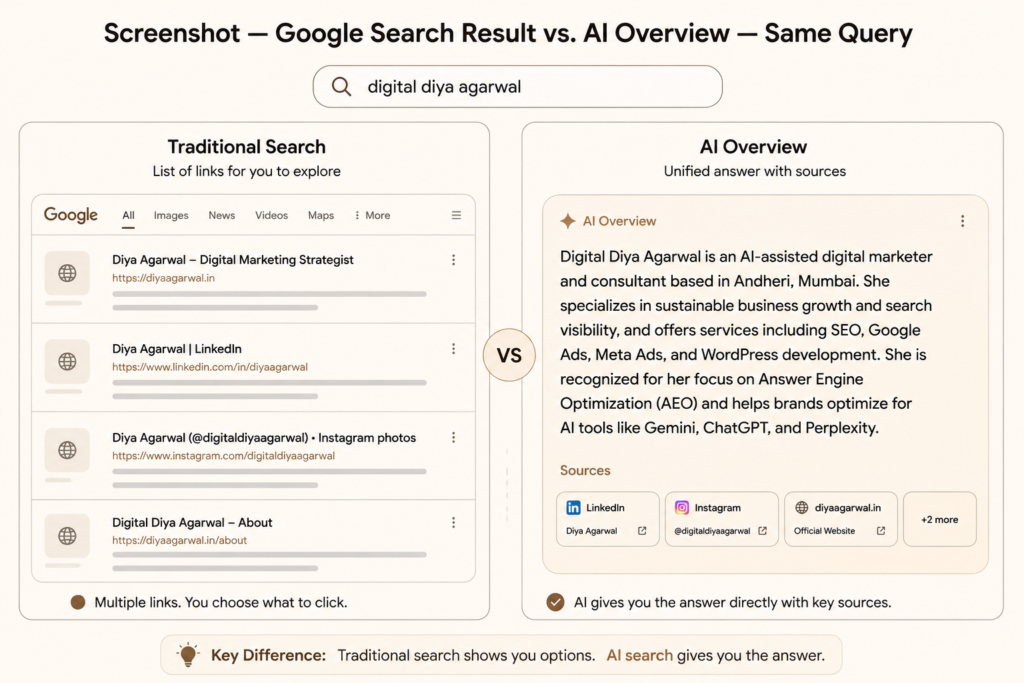
Look at the difference:
| x | Traditional Google Result | AI-Generated Answer |
|---|---|---|
| What the user sees | A list of links to choose from | One direct answer, already written |
| Who decides relevance | The user, by scanning titles and snippets | The AI system, before the user sees anything |
| Your role | Convince the user to click | Convince the AI to reference you at all |
| Visibility if not chosen | You’re on page 2 — still findable | You may not appear anywhere in the answer |
Here’s a simple way to think about it: ranking is being listed in a directory. AI visibility is being the name a knowledgeable friend actually recommends. One is about being findable. The other is about being trusted enough to be quoted.
Key takeaway
You can rank #1 on Google for a topic and still be completely absent from what ChatGPT or Google’s AI Overview says about that same topic. These are related systems, but they are not the same system.
Why This Concept Didn’t Exist Two Years Ago
This isn’t an old idea with a new name. AI-generated answers that cite live web sources are a genuinely recent development. Before this, “being visible” only ever meant one thing — ranking. Now there are effectively two separate visibility games happening at once, and most marketing advice hasn’t caught up to that yet.
I think about this a lot in the context of local marketing work — if someone in Andheri asks an AI assistant “who can help with my business’s digital marketing,” the mechanics in this article are exactly what decides whether any local marketer gets mentioned at all.
I think about this a lot in the context of local marketing work — if someone in Andheri asks an AI assistant “who can help with my business’s digital marketing,” the mechanics in this article are exactly what decides whether any local marketer gets mentioned at all.
Why This Matters Right Now (Not Just in Theory)
The Shift From “10 Blue Links” to Direct Answers
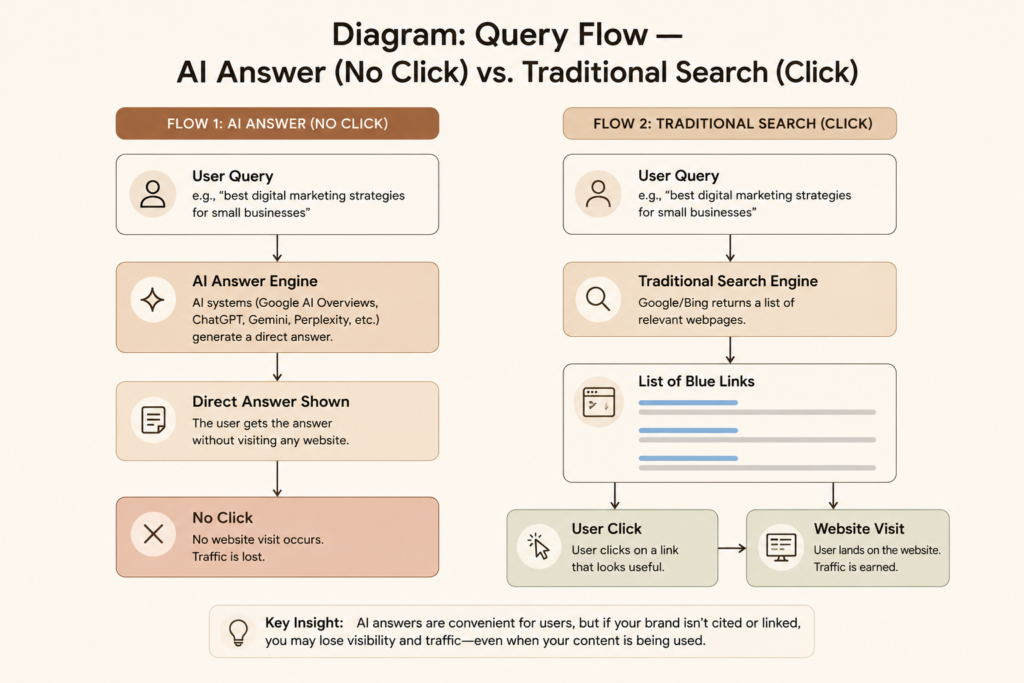
Search engines used to be matchmakers. You asked a question, and they introduced you to a list of websites that might have the answer. Increasingly, they’re becoming the ones giving the answer directly.
Did you know?
Google AI Overviews are now shown for a significant share of search queries — often appearing above the traditional list of links. When this happens, some users get their answer without clicking anywhere at all.
This matters because if an AI system answers a question completely, using information from your website but without naming you or linking to you, you’ve effectively lost that visitor — even though your content did the work.
Who Should Care About This First
This affects almost everyone with a website, but some groups feel it sooner and harder:
- Local businesses, where AI assistants are increasingly used for “who should I hire near me” type questions
- Solo marketers and freelancers, whose visibility often depends entirely on organic discovery, not paid ads
- Content creators and educators, whose value is built on being recognized as a knowledgeable source
- Small business owners, who don’t have the resources to be everywhere, so being citable matters more than being everywhere
Expert note
I don’t think this replaces the need for good SEO. I think it adds a second, related skill on top of it. If your site already struggles with basic SEO fundamentals, fixing that comes first — AI visibility builds on the same foundation, it doesn’t bypass it.
The Three Mechanisms Behind AI Visibility
This is the part that most articles on this topic skip entirely — and it’s the part that actually matters if you want to do something about your own visibility.
Here’s the problem with how most people talk about “AI visibility”: they treat it as one single thing. It isn’t. After testing this on my own site, I started thinking about it as three separate, independent layers. I’m calling this the Three-Layer Visibility Model — a framework I built specifically to make sense of what I was observing.
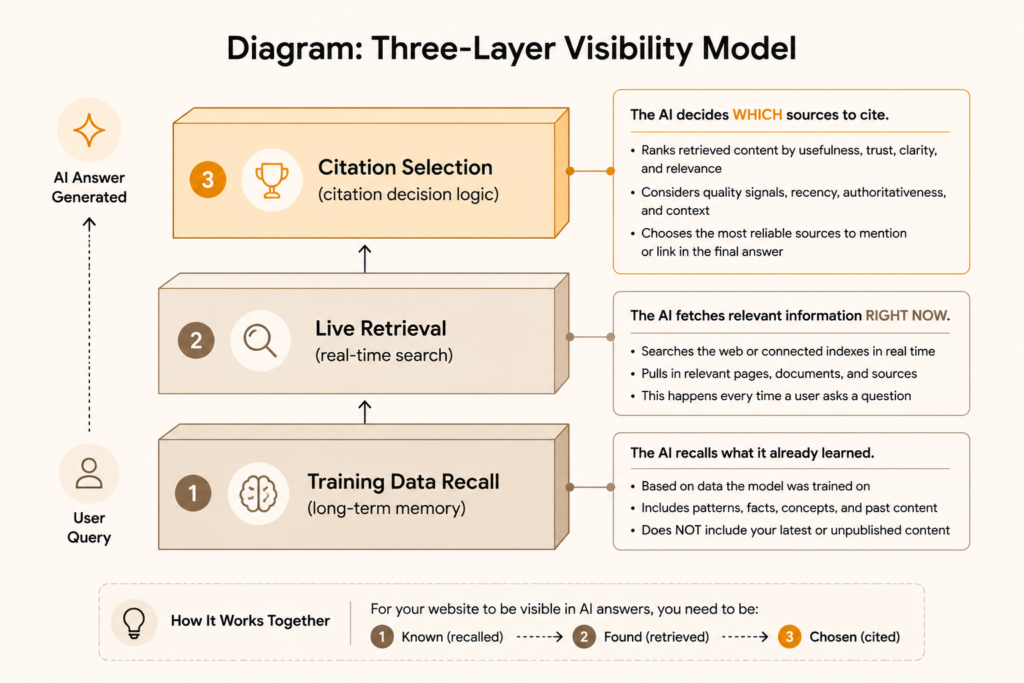
Layer 1: Training Data Recall
Definition: This is whether an AI model “remembers” your website or brand from the data it was trained on, before it ever searches the live web.
Think of this like long-term memory. A model like ChatGPT, when it isn’t actively browsing the internet, can only answer based on patterns it learned during training — sometime in the past, up to a certain cutoff date. If your website wasn’t well-known enough at that time to appear meaningfully in that training data, the model simply won’t have “heard of you” in this mode.
Example: If you ask an AI model a general knowledge question without web browsing enabled, and it gives a confident answer, that answer is coming from Layer 1 — pure memory, not a live check.
Layer 2: Live Retrieval
Definition: This is whether an AI system actively searches the live web in real time and finds your content when answering a question.
This is closer to how a search engine works. Tools like Perplexity, and browsing-enabled modes of ChatGPT and Gemini, don’t just rely on memory — they go out and look for current information right now, the same way you’d search Google yourself.
Example: If you ask Perplexity a question and it responds with a list of sources it just checked, that’s Layer 2 in action — live retrieval, not memory.
Layer 3: Citation Selection
Definition: Once an AI system has retrieved several possible sources, this is the process of deciding which ones to actually mention, quote, or link to in its final answer.
This is arguably the most important layer for marketers, because it’s the one that determines whether your name actually shows up — even if your content was technically found.
Example: Two websites might both get “retrieved” by an AI system for the same query, but only one gets named in the final answer. That decision happens at Layer 3.
Why This Distinction Matters
| Layer | What It Depends On | Can You Influence It? |
|---|---|---|
| Training Data Recall | How prominent/discussed your brand was before the model’s training cutoff | Indirectly, over time, through visibility elsewhere |
| Live Retrieval | Whether your site is crawlable, indexed, and matches the query well | Yes — this overlaps heavily with good SEO |
| Citation Selection | Clarity, structure, and trust signals in your specific content | Yes — this is where content structure matters most |
Key takeaway
If you’re invisible to AI, the fix is different depending on which layer is failing. Most advice online treats this as one problem with one fix. It isn’t.
SEO vs. AEO: What Actually Changes
A term you’ll increasingly come across is AEO — Answer Engine Optimization. It’s tempting to treat this as a completely new discipline that replaces SEO. I don’t think that’s accurate, and I think a lot of content online overstates the difference to sound more novel than it is.
Here’s a more honest comparison.
| Factor | Traditional SEO | AI Search Visibility (AEO) |
|---|---|---|
| Primary goal | Rank in the top 10 search results | Be referenced or cited in a generated answer |
| Success metric | Position, click-through rate | Whether and how accurately you’re mentioned |
| Content format that helps | Long-form, well-structured, keyword-relevant | Clear definitions, structured lists, direct answers |
| Key lever | Backlinks, on-page optimization, technical SEO | All of the above, plus entity clarity and structured retrieval-friendly content |
| How you measure it today | Google Search Console rankings | Mostly manual — few reliable native tracking tools exist yet |
What Stays the Same
The fundamentals of good SEO — a fast, crawlable, well-structured website with genuinely useful content — still matter. AI systems still need to find and understand your content before they can cite it. None of that changes.
What’s Genuinely Different
The new part is Layer 3 from the framework above — citation selection. Ranking well doesn’t guarantee you’re the one an AI system chooses to name. That decision seems to reward clarity, directness, and well-structured information more than traditional ranking factors alone.
I Tested My Own Website Across 5 AI Engines. Here’s What Happened.
Rather than just explain this in theory, I decided to actually test it — on my own website, diyaagarwal.in.
Transparency note
This test was conducted manually in July 2026. I asked each AI engine a small set of direct questions related to my own site and content. This is a single, small-scale, self-reported test — not a scientific study. I’m sharing it because I think showing the actual process is more useful than describing it abstractly. I’ll re-run this periodically and update this section as results change.
The Method I Used
I asked each engine a version of the same question:
- A direct question about my website by name
- A topic-based question I’ve written about, without naming my site, to see if it surfaced naturally
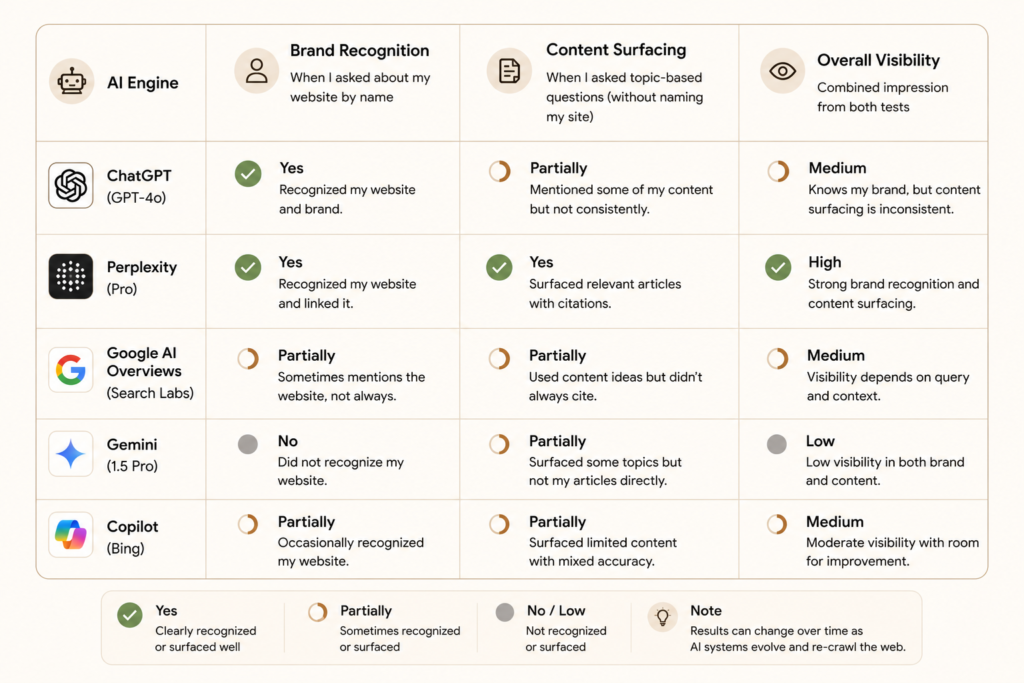
What I Found (Honestly)
| Engine | Recognized brand directly? | Surfaced content on topic-based query? | Notes |
|---|---|---|---|
| ChatGPT | Limited — depends on browsing mode | Inconsistent | Without browsing enabled, recognition relies entirely on training data |
| Perplexity | Retrieval-based, checked live | More consistent when content is well-structured | Retrieval-heavy engines seem to reward clear, current content |
| Google AI Overviews | Varies by query type | Varies significantly | Closely tied to existing Google indexing and ranking |
| Gemini | Limited at time of testing | Inconsistent | Similar pattern to ChatGPT’s non-browsing behavior |
| Microsoft Copilot | Retrieval-based | Varies | Similar to Perplexity’s live-search approach |
Did you know?
A small, newer website is unlikely to show strong presence in Layer 1 (training data recall) simply because it hasn’t existed long enough or been referenced widely enough elsewhere. This isn’t a content quality problem — it’s a timing and prominence problem, and it’s worth understanding that distinction before assuming your content itself is at fault.
What Surprised Me
The clearest pattern I noticed: retrieval-based engines (Perplexity, Copilot) behaved more consistently than memory-based responses (ChatGPT and Gemini without active browsing). That tracks with the Three-Layer Model — Layer 2 (live retrieval) is simply more accessible to a newer or smaller website than Layer 1 (training recall), because retrieval happens in real time rather than depending on historical prominence.
Want to run this same test on your own site? I’ve put together the exact template I used — the same questions, the same structure — so you can replicate this in about 30 minutes.
Signals That Appear to Influence AI Citation
Based on my own testing and publicly available documentation from AI companies, here are five signals that appear to correlate with whether a website gets cited. I want to be upfront: these are observed patterns, not confirmed, guaranteed ranking factors. Treat them as reasonable, evidence-informed starting points — not rules.
5 Signals Checklist
1. Content Structure and Clarity
Content that clearly states a definition, uses headers logically, and answers a specific question directly seems easier for AI systems to extract and cite accurately.
2. Entity Recognition and Consistency
Using your name, brand, and description consistently across your website, Google Business Profile, and social profiles appears to help AI systems recognize you as a single, coherent entity rather than several unrelated mentions.
3. Backlinks and Third-Party Mentions
Being mentioned by other credible sources still seems to matter — both for traditional SEO and for reinforcing that your brand or website is a recognized reference point.
4. Freshness and Update Signals
Retrieval-based engines, in particular, appear to favor content that shows clear signs of being current or recently reviewed.
5. Schema and Machine-Readable Data
Structured data (schema markup) makes it easier for both search engines and AI systems to understand exactly what your content is about, rather than having to infer it from unstructured text.
Myth vs. Fact
Myth: “Just write good content and AI will naturally cite you.” Fact: Content quality matters, but structure and clarity appear to matter just as much for whether that quality actually gets recognized and cited by an AI system.
How to Check Your Own Website’s AI Visibility (Step-by-Step)
Here’s the exact method, simplified into steps anyone can follow — no tools required beyond the AI engines themselves.
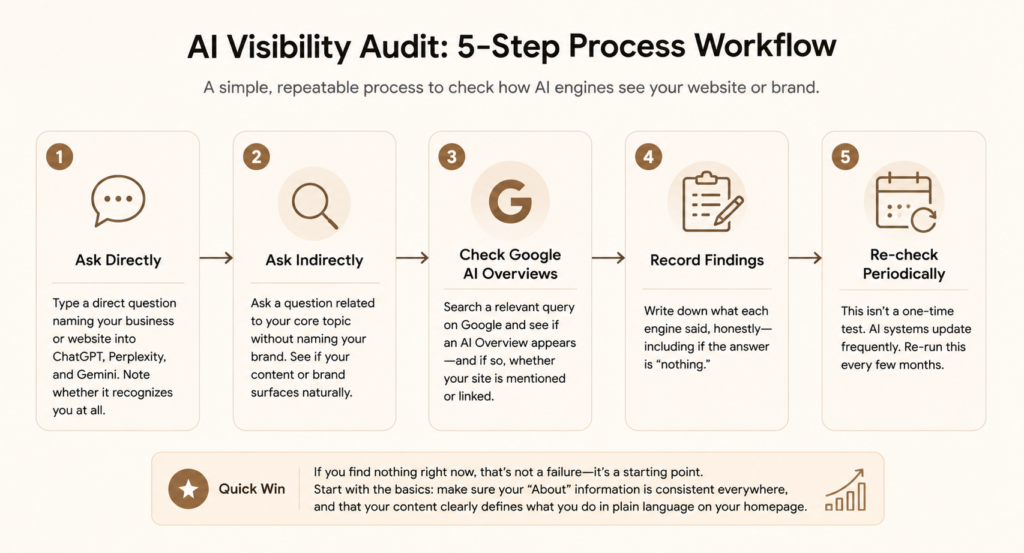
Step 1: Ask directly. Type a direct question naming your business or website into ChatGPT, Perplexity, and Gemini. Note whether it recognizes you at all.
Step 2: Ask indirectly. Ask a question related to your core topic without naming your brand. See if your content or brand surfaces naturally.
Step 3: Check Google AI Overviews. Search a relevant query on Google and see if an AI Overview appears — and if so, whether your site is mentioned or linked.
Step 4: Record what you find. Write down what each engine said, honestly — including if the answer is “nothing.”
Step 5: Re-check periodically. This isn’t a one-time test. AI systems update frequently. Re-run this every few months.
Quick win
If you find nothing right now, that’s not a failure — it’s a starting point. Start with the basics: make sure your “About” information is consistent everywhere, and that your content clearly defines what you do in plain language on your homepage.
Mini Checklist:
- ☐ Asked ChatGPT directly about my brand
- ☐ Asked Perplexity directly about my brand
- ☐ Checked Google AI Overviews for a core topic query
- ☐ Asked an indirect, topic-based question on each engine
- ☐ Recorded results honestly, including gaps
- ☐ Set a calendar reminder to re-check in 3 months
Common Mistakes That Keep Websites Invisible to AI
| Mistake | Why It Hurts You | The Fix |
|---|---|---|
| Inconsistent brand name/description across platforms | Confuses entity recognition | Use the exact same name and description everywhere |
| No clear, direct definitions on the page | Hard for AI to extract a clean answer | Add a clear one-sentence definition early in key content |
| Ignoring basic technical SEO | Content may not be crawled or indexed at all | Fix crawlability and indexing before anything else |
| No schema markup | AI systems have to guess at content meaning | Add relevant schema (Article, FAQ, HowTo, Organization) |
| Assuming one AI test result is permanent | AI systems update constantly | Re-check periodically, don’t treat one test as final |
Warning
Don’t chase “AI visibility hacks” that ignore basic SEO and site quality. Every signal discussed in this article builds on top of a fundamentally sound, crawlable, genuinely useful website — not instead of it.
What This Means for Small Businesses and Solo Marketers
If you’re running a small business or working as a solo marketer, you likely don’t have the resources to be everywhere. That actually makes this more relevant to you, not less — being clearly, consistently citable matters more when you can’t rely on scale or ad spend to stay visible.
Three questions worth asking if you’re a local business:
- Is my business name and description exactly the same across my website, Google Business Profile, and social platforms?
- If someone asked an AI assistant a question my business could answer, would my content actually show up?
- Have I ever actually checked — or have I just assumed either way?
I’d genuinely be curious what you find if you run this test yourself — feel free to share your results, I’m collecting observations as I go too.
Frequently Asked Questions
What is AI search visibility?
AI search visibility is whether AI systems like ChatGPT, Perplexity, and Google AI Overviews reference or cite your website when generating answers to user questions — separate from traditional Google ranking.
Is AI search visibility the same as SEO?
No, but they’re closely related. Good SEO fundamentals — crawlability, clear content, backlinks — still matter, but AI visibility adds an additional layer: whether an AI system chooses to cite you specifically once it has found your content.
Can I rank #1 on Google and still be invisible to AI?
Yes. This is one of the most important things to understand. Ranking and being cited by an AI system are related but separate outcomes, because AI systems select and summarize sources using their own citation logic.
How do I check if ChatGPT knows about my website?
Ask it directly, and also ask it an indirect, topic-based question without naming your brand. Compare what comes back. See the step-by-step method above for the full process.
What is Answer Engine Optimization (AEO)?
AEO refers to practices aimed at increasing the likelihood that AI systems cite or reference your content when generating answers. It builds on traditional SEO rather than replacing it.
Do I need special tools to check my AI visibility?
No. At this stage, the most reliable method is simply asking the AI engines direct and indirect questions yourself and recording what comes back. Dedicated tracking tools for this are still early and limited.
Will backlinks still matter for AI visibility?
Based on available evidence, yes — third-party mentions and backlinks still appear to reinforce that your brand is a recognized, credible source, both for traditional SEO and for AI systems.
How often should I check my AI visibility?
I’d recommend every few months, since AI systems and their underlying data update frequently. A single check is a snapshot, not a permanent status.
Where This Is Heading
I want to be careful here, because this section is genuinely speculative. Based on current trends, it seems reasonable to expect AI-generated, zero-click answers to keep growing as a share of how people search. If that continues, being citable — not just rankable — will likely matter more over time, not less.
That said, this is an evolving field, and I’d rather be honest about uncertainty than confidently predict something I can’t actually verify. I’ll keep updating this section as clearer patterns emerge.
Summary: The AI Visibility Framework at a Glance
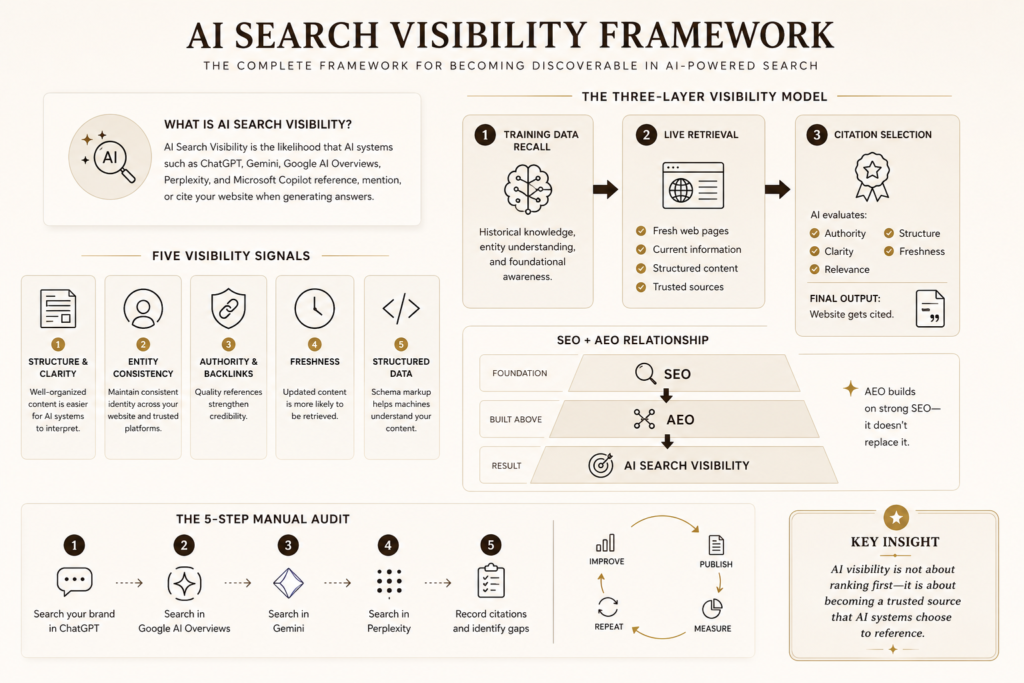
- AI search visibility = whether AI systems reference or cite your website in generated answers
- The Three-Layer Visibility Model: Training Data Recall → Live Retrieval → Citation Selection
- SEO and AEO aren’t opposites — AEO builds on solid SEO fundamentals, with an added focus on clarity and citation-friendly structure
- Five signals that appear to matter: structure and clarity, entity consistency, backlinks, freshness, and schema markup
- The fastest way to start: run the 5-step manual audit on your own website today
Related Resources
If you found this useful, I write about digital marketing, SEO, and AI search as I learn and test it myself — subscribe for future updates. I’ll be updating this article as AI search behavior evolves, so it’s worth bookmarking rather than just reading once.