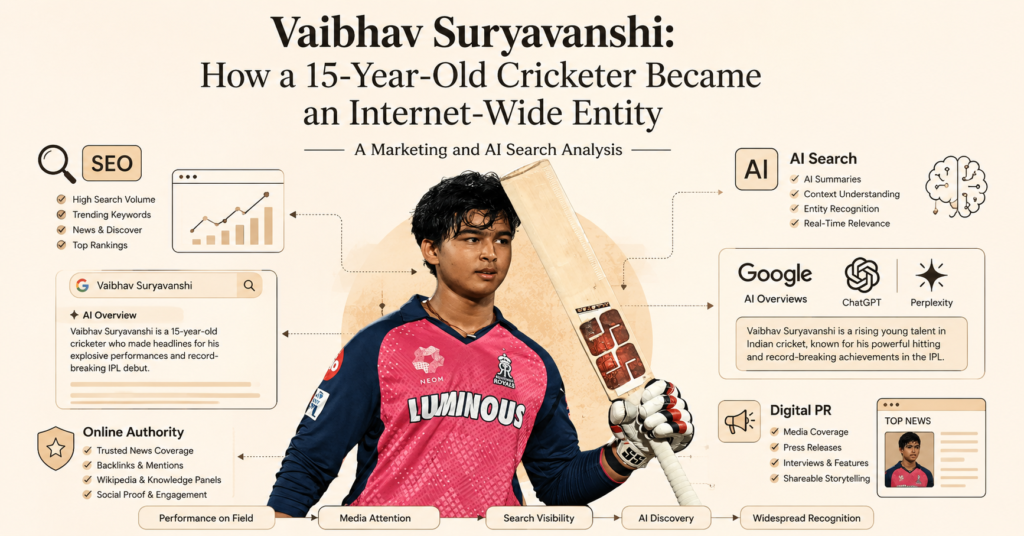
Vaibhav Suryavanshi: How a 15-Year-Old Cricketer Became an Internet-Wide Entity (An SEO, AI Search & Digital PR Analysis)
Editorial Note This article analyzes publicly observable search behavior, media coverage, digital PR signals, and AI search visibility surrounding Vaibhav Suryavanshi. It does not speculate about private marketing strategies or internal search engine systems. Instead, it uses a real-world sporting story to explain how modern search engines and AI-powered platforms discover, understand, and recommend information. A digital marketing analysis of how one remarkable cricket story expanded across search engines, AI systems, and trusted news platforms. A Cricket Story That Became Much Bigger Than Cricket Every few years, the internet witnesses a story that spreads far beyond its original audience. Sometimes it begins with a groundbreaking startup, sometimes a technological breakthrough, and sometimes an extraordinary sporting achievement. The rapid rise of Vaibhav Suryavanshi is one such example. What began as a remarkable cricketing story quickly transformed into something much larger—a digital phenomenon discussed across sports journalism, social media platforms, search engines, and AI-powered search experiences. Within days, millions of people weren’t simply watching cricket; they were searching. They wanted to know: who is Vaibhav Suryavanshi? Why is everyone talking about him? How old is he? Which team does he represent? And what records has he broken? Those questions created an explosion of online demand. For digital marketers, that is fascinating because the internet wasn’t merely reacting to a young cricketer; it was collectively building a digital entity. And that process reveals some valuable lessons about how modern search works. Before We Talk About SEO, Let’s Understand the Bigger Picture For years, digital marketers have measured success through familiar metrics like Google rankings, organic traffic, click-through rates, backlinks, Domain Authority, and keyword positions. Those metrics still matter, but the internet has changed. Today, information no longer travels through just one channel. A single newsworthy event can rapidly spread across an interconnected ecosystem of news publishers, search engines, social media platforms, video platforms, discussion forums, Knowledge Graphs, and AI assistants like ChatGPT, Gemini, Claude, Microsoft Copilot, and Perplexity. Each platform contributes another signal, each mention reinforces credibility, and each authoritative source increases discoverability. This interconnected web is exactly why some stories become impossible to ignore online. Understanding the Difference Between Popularity and Digital Visibility Popularity and digital visibility often appear to be the same thing, but they aren’t. A person may become popular in the real world without immediately becoming highly visible online. Likewise, someone can dominate search results without being widely recognized outside the internet. Concept Definition: Digital Visibility Digital visibility happens when information becomes consistently available across trusted sources. In simple terms, search engines and AI systems gain confidence when multiple independent publications describe the same person using consistent facts. That is what turns isolated articles into a recognized digital identity. From Cricket Headlines to Search Engines One outstanding performance doesn’t automatically make someone discoverable across the internet; what happens next is equally important. After a major sporting achievement, several things typically occur almost simultaneously. Sports journalists publish match reports, news organizations write feature stories, television channels upload interviews, fans create videos, creators publish reactions, social media discussions multiply, and Wikipedia editors may eventually document notable achievements. As search demand begins climbing, hundreds—or even thousands—of webpages begin referring to the same person. Search engines observe this growing consistency, and AI systems begin encountering the same entity across multiple trusted sources. That doesn’t happen because one website said so; it happens because many credible sources independently reinforce the same information. Multiple Trusted Sources Strengthen Credibility One of the strongest signals on today’s internet is independent confirmation. Imagine reading about a new technology on only one unknown blog. Now imagine reading about the same technology on Reuters, ESPNcricinfo, Cricbuzz, The Times of India, Indian Express, and NDTV Sports. Your confidence naturally increases. Search engines behave similarly. AI systems also benefit from consistent information appearing across multiple reputable publishers. This is why large news events often become highly visible inside AI-generated answers—not because one article exists, but because dozens of trusted publications are discussing the same topic. Readers who want to explore more about Vaibhav Suryavanshi’s cricket journey can refer to established sports publishers such as ESPNcricinfo’s player profile, Cricbuzz’s player page, and coverage from Reuters and The Times of India, all of which provide reliable reporting and historical context. Why Millions Suddenly Started Searching for Vaibhav Suryavanshi Search demand rarely stays limited to one keyword; instead, it expands into an entire ecosystem of related questions. For example, once public interest increases, users naturally begin searching variations like his age, biography, stats, IPL status, records, family, latest news, and cricket career. Notice something interesting: most people aren’t searching for one webpage. They’re searching for answers. And that’s exactly where AI-powered search begins changing how information is discovered. What This Means for Digital Marketers At first glance, this might seem like a story about cricket, but it isn’t. It’s a story about information. More specifically, it’s a story about how information spreads, gains credibility, and becomes discoverable across today’s internet. Businesses, consultants, creators, and personal brands can learn an important lesson from this: visibility is no longer created by publishing one optimized webpage. Instead, visibility grows when consistent, trustworthy information appears across an ecosystem of reliable sources. That principle applies equally to athletes, businesses, startups, educators, consultants, and personal brands. The platforms may differ, but the underlying mechanics remain surprisingly similar. How AI Search Sees a Trending Public Figure Traditional search engines and modern AI search systems solve the same problem differently. For nearly three decades, search engines primarily acted as directories: you asked a question, they returned a list of webpages, and you decided which one deserved your click. AI search changes that experience completely. Instead of showing ten blue links and asking users to choose, AI systems attempt to answer the question directly by synthesizing information from multiple reliable sources. Imagine someone asking: “Who is Vaibhav Suryavanshi?” An AI assistant doesn’t simply retrieve one article; it evaluates information available across trusted publishers, sports databases, official records, and other authoritative sources before generating