
What Happens When One Person Has the Tools of an Entire Marketing Department?
The Marketing Team That Never Existed
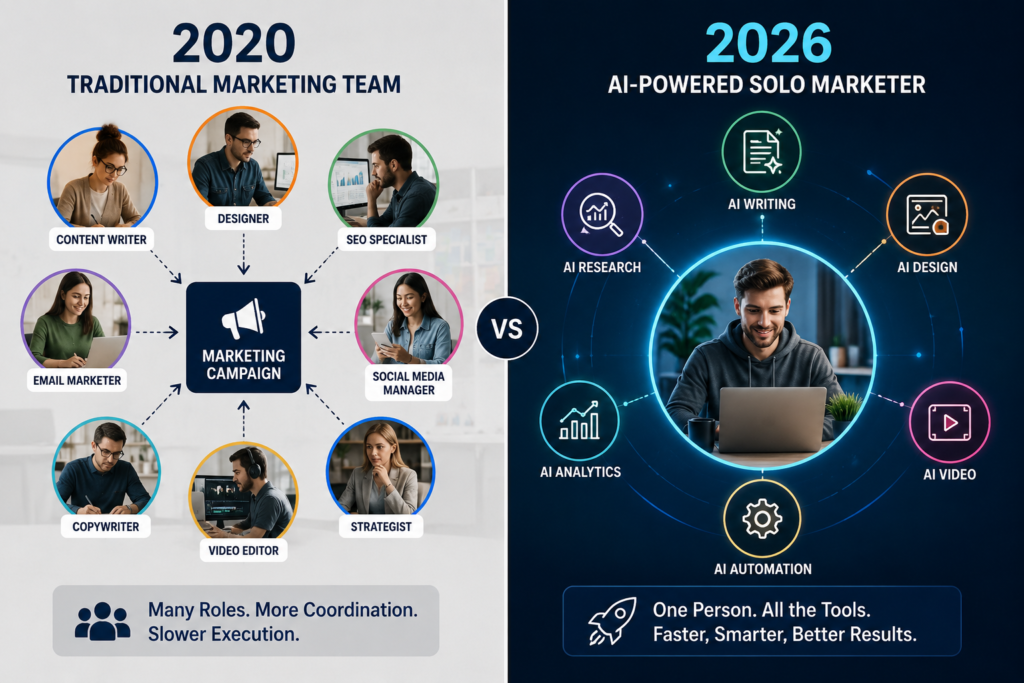
A few years ago, building a serious marketing operation required a team.
You needed a content writer to create blog posts.
A designer to create visuals.
A social media manager to publish content.
A copywriter to write ads.
An SEO specialist to optimize pages.
An email marketer to nurture leads.
A video editor to create short-form content.
A strategist to tie everything together.
For most small businesses, creators, freelancers, and startups, assembling such a team was nearly impossible.
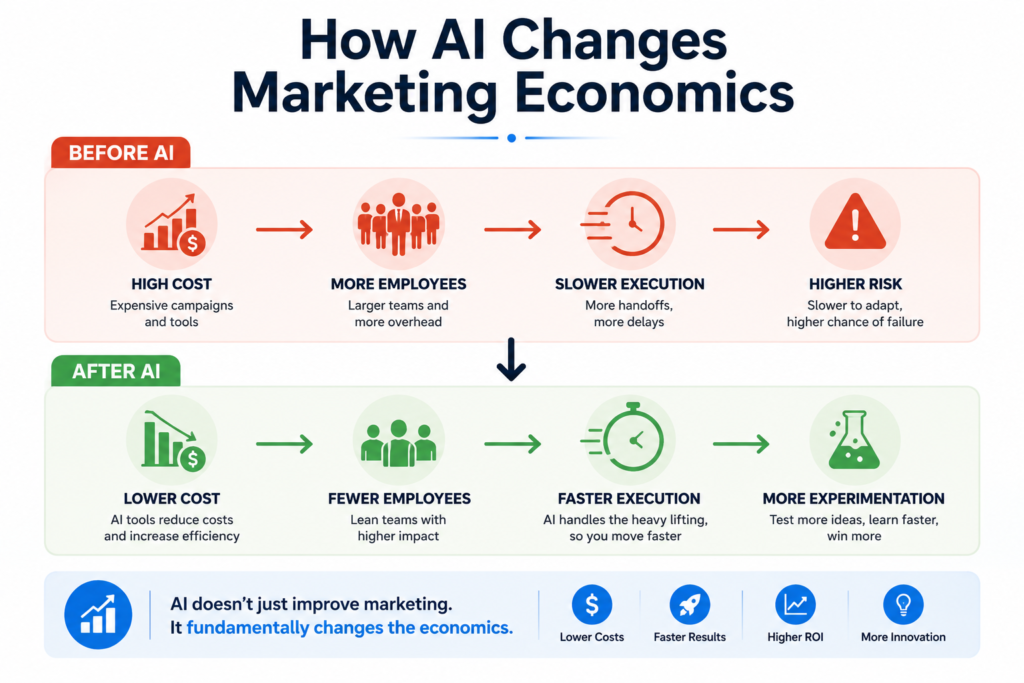
The cost was high.
The coordination was difficult.
And growth often depended on how many people you could afford to hire.
Today, something remarkable is happening.
One person can do work that previously required an entire department.
Not because humans suddenly became superhuman.
Because AI has fundamentally changed how marketing gets done.
And whether you’re a creator, freelancer, entrepreneur, student, or business owner, understanding this shift might be one of the most important skills you develop over the next few years.
Why This Matters More Than Most People Realize
When people hear about AI in marketing, they usually think about writing a few captions or generating images.
That’s the surface-level view.
The real story is much bigger.
AI is not simply helping marketers work faster.
It is changing the economics of marketing itself.
Tasks that once took hours now take minutes.
Activities that required specialists are becoming accessible to generalists.
Ideas can move from concept to execution at unprecedented speed.
This means smaller players suddenly have a chance to compete with larger organizations.
A solo creator can build a media presence.
A local business can produce professional marketing campaigns.
A freelancer can offer services that previously required an agency.
A startup can launch with far fewer resources.
The playing field isn’t perfectly equal.
But it is becoming significantly more accessible.
And that changes everything.
The New Reality: One Person, Multiple Roles
Let’s imagine a creator named Rahul.
Three years ago, Rahul wanted to launch a personal brand.
To do it properly, he needed:
- A website
- Blog content
- Social media posts
- Email newsletters
- SEO optimization
- Video scripts
- Graphic design
- Marketing strategy
The workload alone would overwhelm most people.
Today, Rahul can use AI tools to:
- Research audience pain points
- Generate content outlines
- Draft blog posts
- Create social media variations
- Design graphics
- Generate video ideas
- Optimize content for SEO
- Analyze performance metrics
The result?
Rahul still does the thinking.
He still provides the ideas.
He still makes the decisions.
But AI dramatically reduces the operational burden.
Instead of spending 80% of his time creating assets, he spends more time building relationships, improving strategy, and understanding his audience.
That’s the real advantage.
What AI Is Actually Replacing
Let’s be careful with the language.
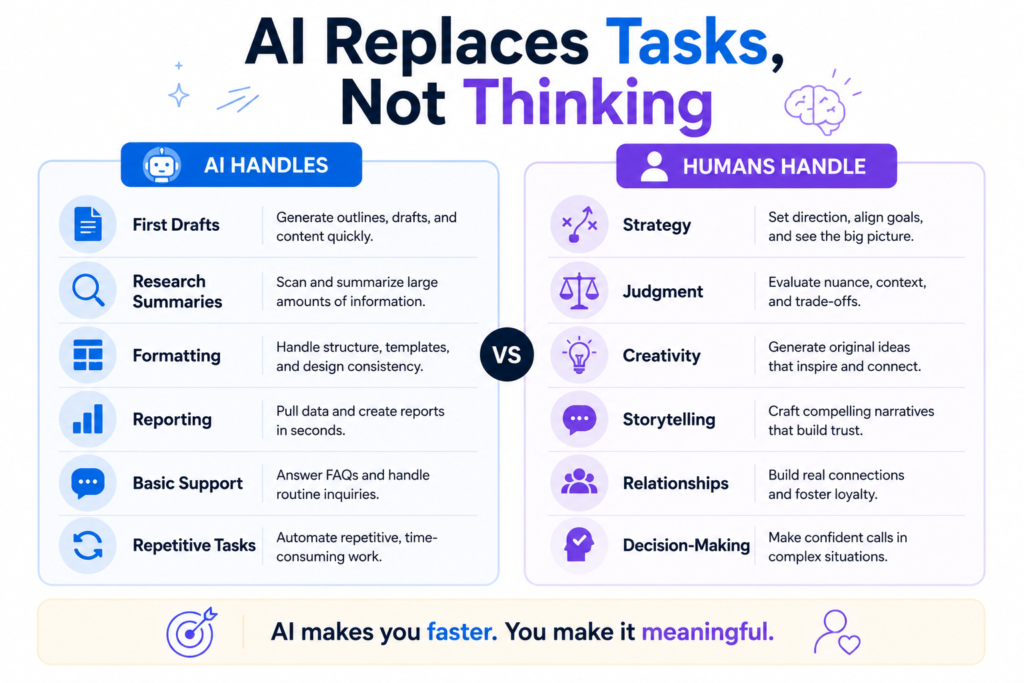
AI is not replacing marketing.
AI is replacing repetitive marketing tasks.
There’s a huge difference.
Content Production
Creating the first draft of a blog article used to take hours.
Now AI can generate a strong starting point in minutes.
The marketer’s role shifts from writing everything from scratch to guiding, editing, improving, and adding expertise.
Research
Market research once required extensive manual effort.
AI can now summarize trends, analyze competitors, identify content gaps, and organize information quickly.
Design Assistance
Designers are still valuable.
But many businesses no longer need a full-time designer for every visual asset.
AI-powered design tools can help create social graphics, ad creatives, thumbnails, presentations, and marketing materials.
Customer Support
Basic customer inquiries can often be handled by AI systems.
This allows human teams to focus on more complex interactions.
Analytics Interpretation
Modern AI tools can identify trends, summarize reports, and highlight insights that would otherwise require hours of manual analysis.
The common theme?
AI handles repetitive execution.
Humans focus on judgment.
The Most Valuable Marketing Skill Is Changing
For years, marketers were rewarded for execution.
Knowing how to create content.
Knowing how to write copy.
Knowing how to build campaigns.
These skills still matter.
But another skill is becoming even more important.
The ability to think.
Specifically:
- Strategic thinking
- Audience understanding
- Storytelling
- Positioning
- Decision-making
- Creativity
Because if everyone has access to similar AI tools, the difference won’t be the technology.
The difference will be the person using it.
The question shifts from:
“Can you create content?”
To:
“Can you create content worth consuming?”
That is a much harder challenge.
And much more valuable.
Real-World Examples Happening Right Now
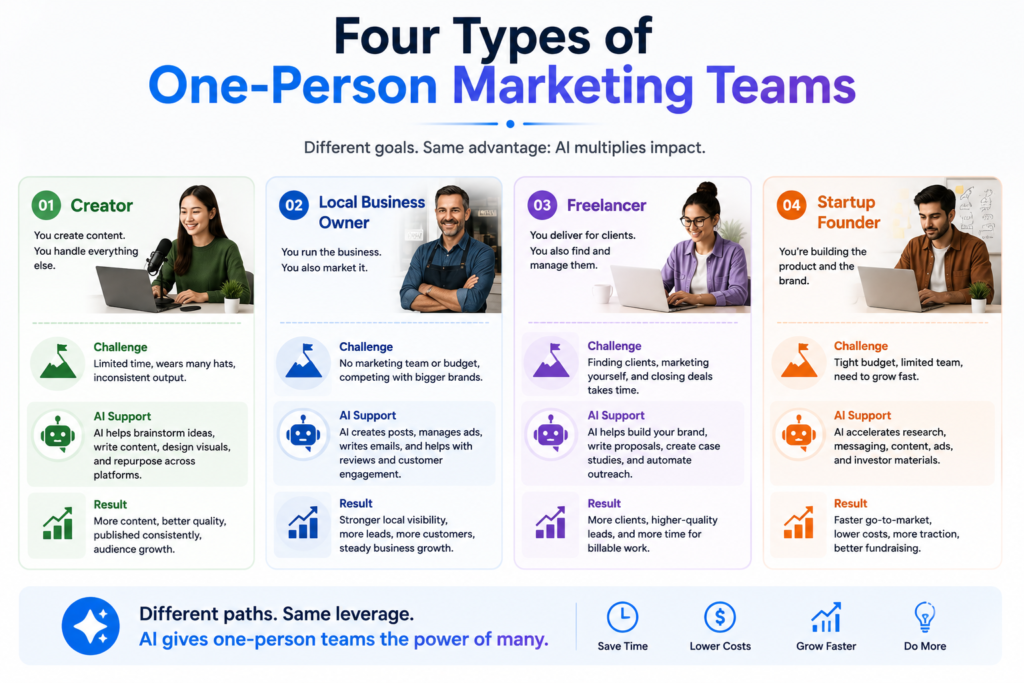
The Solo Creator
A YouTuber can use AI to:
- Generate content ideas
- Research topics
- Create outlines
- Write drafts
- Generate thumbnails
- Repurpose content across platforms
Instead of hiring multiple specialists, they operate as a small media company.
The Local Business Owner
A restaurant owner can:
- Generate social media campaigns
- Write promotional emails
- Create menu descriptions
- Produce advertisements
- Analyze customer feedback
Without a dedicated marketing department.
The Freelancer
A freelancer who once offered only content writing can now provide:
- Content strategy
- SEO optimization
- Email marketing
- Audience research
- Social media planning
Not because they mastered every discipline overnight.
Because AI helps bridge execution gaps.
The Startup Founder
A founder can validate ideas, build audiences, create landing pages, publish content, and run campaigns before making their first marketing hire.
That dramatically changes startup economics.
The Hidden Risk Nobody Talks About
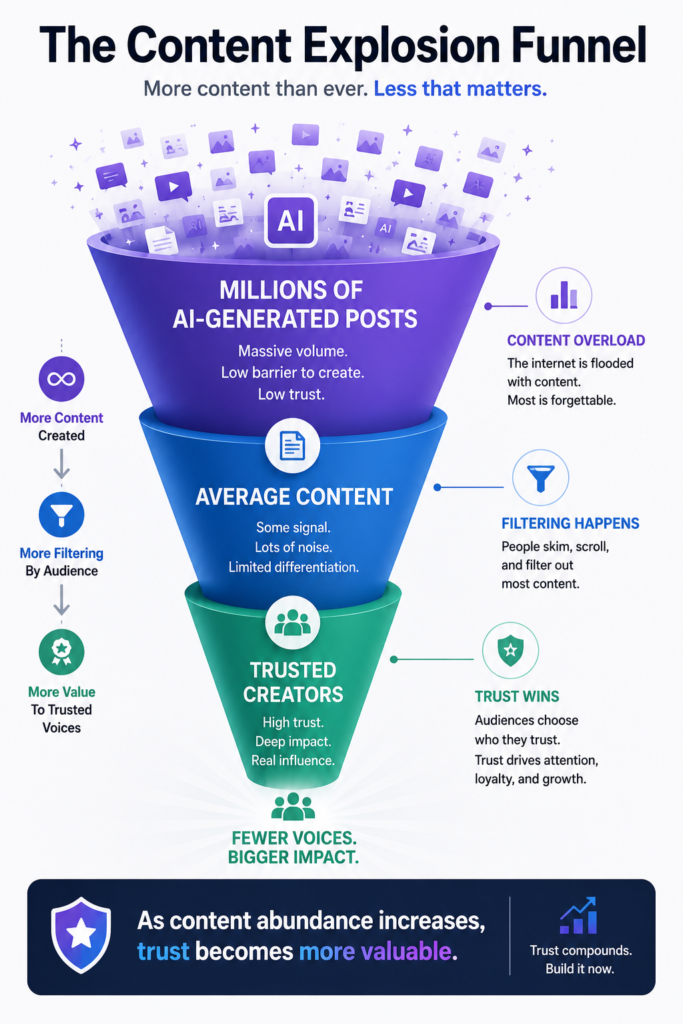
There is one problem.
When everyone has access to AI, average content becomes easier to produce.
And the internet is already flooded with average content.
More articles.
More videos.
More posts.
More newsletters.
More noise.
Simply producing more content is no longer enough.
The winners will not be the people who use AI the most.
The winners will be the people who use AI intelligently while remaining deeply human.
Because audiences still connect with:
- Authentic stories
- Unique experiences
- Original insights
- Honest opinions
- Real expertise
AI can help create content.
It cannot replace genuine lived experience.
At least not today.
What I’m Learning While Building Digital Diya
One of the biggest lessons I’ve learned while building Digital Diya is that technology rarely creates trust.
People do.
AI can help me research faster.
AI can help me organize ideas.
AI can help me improve productivity.
But readers don’t follow creators because of their tools.
They follow creators because of their perspective.
Every creator now has access to powerful technology.
What remains scarce is originality.
When I think about the future of marketing, I don’t see a world where AI replaces creators.
I see a world where creators who understand AI outperform creators who ignore it.
The advantage isn’t automation alone.
The advantage is combining technology with human insight.
That’s where real opportunities exist.
How to Build Your Own One-Person Marketing Team
If you’re just getting started, don’t try to use every AI tool available.
Focus on solving real problems.
Step 1: Understand Your Audience
Before touching any tool, answer:
- Who are you helping?
- What problems do they face?
- What outcomes do they want?
Without audience clarity, AI simply helps you create irrelevant content faster.
Step 2: Build a Simple Content System
Create:
- One long-form article
- Multiple social posts
- One email newsletter
- One video concept
Use AI to repurpose intelligently.
Step 3: Automate Repetitive Work
Identify tasks that consume time but don’t require deep thinking.
Examples:
- Content formatting
- Research summaries
- Caption generation
- Meeting notes
- Basic reporting
These are excellent candidates for automation.
Step 4: Protect Your Human Advantage
Invest in:
- Learning
- Experience
- Communication
- Storytelling
- Relationships
These become increasingly valuable as AI becomes more accessible.
Step 5: Stay Curious
The AI landscape changes rapidly.
The people who continue learning gain compounding advantages.
Not because they know every tool.
Because they adapt faster than others.
Common Mistakes People Make
Mistake #1: Letting AI Think for Them
AI should support thinking.
Not replace it.
Mistake #2: Publishing Everything AI Generates
First drafts are rarely final drafts.
Editing is where expertise shows up.
Mistake #3: Ignoring Strategy
Technology cannot fix poor positioning.
Mistake #4: Chasing Every New Tool
Mastering a few tools beats constantly switching between dozens.
Mistake #5: Forgetting the Audience
People don’t care about your workflow.
They care about the value you provide.
Always remember that.
Key Takeaways
- AI is reducing the need for large marketing teams.
- One person can now perform work that previously required multiple specialists.
- The most valuable skills are shifting toward strategy, creativity, and audience understanding.
- AI replaces repetitive execution more effectively than human judgment.
- Authenticity, expertise, and original thinking remain major competitive advantages.
- The future belongs to people who combine human insight with AI capabilities.
Your Next Move
If you’re a creator, freelancer, student, marketer, or business owner, don’t ask:
“Will AI replace me?”
Ask:
“How can AI help me become more effective?”
That’s a much better question.
Start small.
Choose one repetitive task.
Automate it.
Use the time you save to deepen your expertise, understand your audience, and create better work.
Because the goal isn’t to become a machine.
The goal is to become more human while technology handles the repetitive parts.
And those who learn that balance early will have a significant advantage in the years ahead.
Final Thoughts
The future of marketing may not belong to massive departments.
It may belong to small, agile teams.
Sometimes teams of one.
But having access to the tools of an entire marketing department doesn’t automatically create success.
Success still comes from understanding people.
Understanding problems.
Creating value.
Building trust.
Technology changes.
Human nature doesn’t.
And that is exactly why the most successful marketers of the future won’t simply be AI users.
They’ll be people who know how to connect with other people—while using AI as a powerful amplifier.
If these ideas resonate with you, consider joining the growing Digital Diya community. The conversations around AI, marketing, personal branding, and creator growth are only getting started, and the people who learn together often grow faster together.
The future is being built right now.
The question is:
Will you watch it happen, or will you help shape it?