
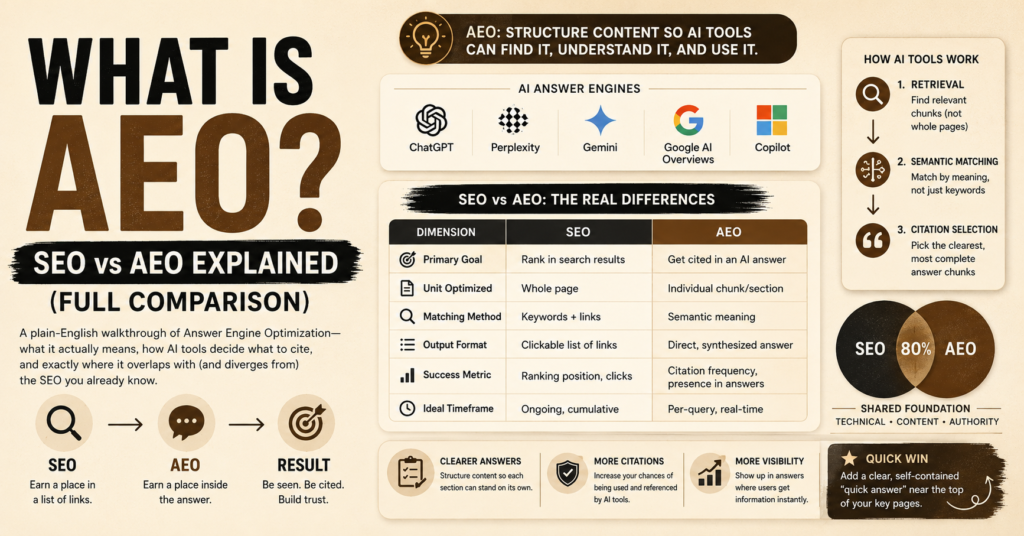
A plain-English walkthrough of Answer Engine Optimization — what it actually means, how AI tools decide what to cite, and exactly where it overlaps with (and diverges from) the SEO you already know.
AEO (Answer Engine Optimization) is the practice of structuring content so AI tools — ChatGPT, Perplexity, Gemini, Google AI Overviews — can find it, understand it, and use it directly as an answer. Where SEO earns you a place in a list of links, AEO earns you a place inside the answer itself.
What Is AEO (Answer Engine Optimization)?
A Simple Definition
Answer Engine Optimization is the work of shaping content so that AI systems can locate it, understand what it’s actually saying, and use it directly when they generate an answer for someone. It sits alongside SEO rather than instead of it — the two share most of the same foundation, and we’ll get into exactly where they part ways further down.
Here’s a useful way to picture the difference in purpose. Traditional SEO content is often written like a magazine feature — it’s meant to be opened, read from top to bottom, and experienced as a whole page. AEO content is written more like a well-built reference entry: every section needs to survive being lifted out, read completely on its own, and still make total sense. Good content today usually needs to do both jobs at once.
Where the Term Came From and Why It Matters Now
AEO isn’t a rebrand of SEO, and it isn’t marketing hype either — it’s a fairly direct response to a real shift in how people look things up. For most of the last two decades, “searching” meant typing a phrase into Google and scanning a list of blue links. That’s still true for a huge amount of search behaviour. But increasingly, people are also asking questions directly inside AI chat tools, and Google itself is answering many queries directly on the results page through AI Overviews, before a person ever clicks a link.
That shift matters for anyone who depends on search for visibility, because it changes what “ranking well” even means. A page can rank on page one and still never get read, if an AI Overview or a chat tool has already answered the question using a different source. AEO is simply the set of practices that gives your content a fair shot at being that source, alongside continuing to rank the traditional way.
What “Answer Engines” Actually Means
“Answer engine” is a useful umbrella term for any tool that gives someone a direct answer instead of a list of links to click through. In practice, that currently includes tools like ChatGPT, Perplexity, Google Gemini, Microsoft Copilot, and Google’s own AI Overviews sitting on top of standard search results. Google Search itself still functions primarily as a ranking engine for most queries — the distinction that matters is retrieval and synthesis versus ranking and linking, and that distinction is exactly what the next section unpacks.
Now that we know what AEO is trying to achieve, it’s worth understanding how these tools actually decide what to cite — because that mechanism is where almost all the practical advice comes from.
How Answer Engines Actually Work
This is the part most articles on this topic skip over, and it’s the part that actually explains everything else. In plain terms: AI answer engines don’t work the way Google’s search results page works. Once you understand that difference, the rest of AEO stops feeling like a list of arbitrary rules and starts feeling like common sense.
Retrieval, Not Just Ranking
Traditional search ranking is a bit like a librarian who hands you the ten most popular, most trusted books on a shelf and lets you go find your own answer inside them. Retrieval — which is what AI answer engines do — is closer to a librarian who has actually read every page of every book in the library, and hands you the one specific paragraph that answers your exact question, wherever it happens to live.
That’s why an AI tool will sometimes cite a page that isn’t sitting at position one on Google. It isn’t reading a ranked list and picking the top result — it’s searching for the single clearest, most relevant piece of content that answers the specific question being asked, regardless of that page’s overall ranking position.
How Content Gets “Chunked” and Why It Matters
Before an AI tool can retrieve anything, it first has to break a page down into smaller pieces, usually called “chunks” — a paragraph, a section, sometimes a single sentence. Think of a chunk as an index card cut out of a much longer document. If a paragraph can’t be cut out, handed to someone, and still make complete sense on its own, it probably won’t survive the chunking process either — and it won’t get retrieved, no matter how good the page is as a whole.
This is a big part of why well-scoped subheadings and self-contained paragraphs consistently outperform long, meandering sections that only make sense if you’ve read everything that came before them.
Quick recap before we go further: a chunk is just a self-contained piece of your page. If it can’t stand alone, it can’t get cited. Next: how AI tools actually match a chunk to a question.
Semantic Embeddings vs Keyword Matching
Traditional keyword matching works a bit like searching a book’s index for one exact word. Semantic embeddings work more like asking a friend who has actually read the whole book — they can answer your question correctly even if you phrase it in a completely different way than the book does.
In technical terms, an embedding is a mathematical representation of what a piece of text means, not just which words it contains. This is why repeating your exact keyword everywhere is no longer the advantage it once was. A chunk that clearly and accurately explains a concept in natural language will often out-perform a chunk that’s stuffed with a keyword but light on actual explanation, because the retrieval system is matching on meaning, not on word-for-word overlap.
How Citations Get Selected
Put those three ideas together and the whole system makes sense: a question comes in, it gets compared against chunks of content (not whole pages) using semantic matching (not keyword matching), and the chunks that most precisely and completely answer the question are the ones that get pulled into the final answer — sometimes with a citation, sometimes without one. Clarity, precision, and being genuinely self-contained beat length, keyword density, and even raw domain authority in this specific process.
The good news: none of this requires new software or a technical rebuild. It mostly requires writing more clearly. With the mechanics out of the way, let’s ground this in the SEO fundamentals you probably already know — because that’s exactly where AEO builds from.
What Is SEO? A Quick Refresher
You almost certainly already know this — this is just here so the comparison in the next section lands cleanly.
The Three Pillars of Traditional SEO
⚙️
Technical SEO
✍️
Content SEO
🔗
Authority & Links
Technical SEO makes sure a page can actually be crawled, indexed, and loaded quickly.
Content SEO makes sure the page answers a real query thoroughly and clearly.
Authority — built largely through backlinks, EEAT signals, and topical depth — tells search engines the source can be trusted. These three pillars haven’t gone anywhere, and they still matter just as much for AEO as they do for classic search rankings.
SEO vs AEO: The Real Differences
In short: SEO is optimized to win a place in a ranked list of links; AEO is optimized to win a place directly inside a generated answer. Everything else below is really just the detail behind that one sentence.
Comparison Table — Goals, Inputs, Outputs, Success Metrics
| Dimension | SEO | AEO |
|---|---|---|
| Primary goal | Rank in search results | Get cited in an AI answer |
| Unit optimized | Whole page | Individual chunk/section |
| Matching method | Keywords + links | Semantic meaning |
| Output format | Clickable list of links | Direct, synthesized answer |
| Success metric | Ranking position, clicks | Citation frequency, presence in answers |
| Ideal timeframe | Ongoing, cumulative | Per-query, real-time |
Plain-English view
- Primary goal: SEO wants your page ranked. AEO wants your sentence quoted.
- Unit optimized: SEO thinks in pages. AEO thinks in paragraphs.
- Matching method: SEO leans on keywords and links. AEO leans on meaning.
- Output format: SEO hands someone a list to click through. AEO hands someone the answer directly.
- Success metric: SEO is measured by position and clicks. AEO is measured by how often you show up inside an answer.
- Ideal timeframe: SEO builds slowly over months. AEO is decided fresh, query by query.
Where SEO and AEO Are Identical (The 80% Overlap)
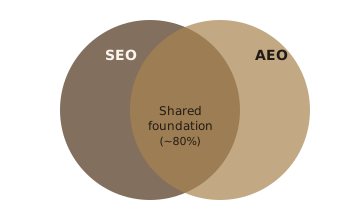
Most of what makes content good for SEO also makes it good for AEO. Technical health, clear writing, accurate information, and genuine topical authority matter to both. If your site is already fast, crawlable, well-written, and trustworthy, you don’t need to throw any of that out or start from zero — you need to layer a smaller, more specific set of practices on top of it.
Where They Genuinely Diverge (The 20% That Matters)
The real differences show up in a handful of specific places: how tightly each section is scoped so it can stand alone, how directly and completely each question gets answered, how much a page relies on structured data like FAQ or HowTo schema, and how “citable” the phrasing itself is — meaning, does it read like a clean, quotable answer, or does it require the reader to have already absorbed three paragraphs of context first. The checklist later in this article walks through exactly which of these to prioritize.
So the two disciplines share almost all of their foundation and differ mainly in structure and phrasing. There’s one more term worth untangling before we move to what to actually do about it: GEO.
Where GEO Fits In (And Why the Terms Get Confused)
AEO vs GEO — Are They the Same Thing?
You don’t need to memorize three separate frameworks here — just one distinction. AEO is about being a good, direct answer to one specific question inside one specific AI tool. GEO (Generative Engine Optimization) is the broader practice of shaping how your brand shows up across any AI-generated output — comparisons, recommendations, summaries, and casual mentions, not just direct Q&A. In short: AEO is one important tool inside the larger GEO toolbox.
| Framework | Primary scope |
|---|---|
| SEO | Ranking in traditional search results |
| AEO | Being cited as a direct answer to a specific question |
| GEO | How a brand is represented across all generative AI output |
This is a genuinely under-covered corner of the topic right now, and it’s worth a dedicated deep-dive of its own — that’s a piece I’m planning separately, so this stays focused rather than sprawling into a third framework here.
Digital Diya Framework — The Decision Framework
When to Prioritize AEO, SEO, or Both
Prioritize SEO first when you’re building foundational, evergreen pages — service pages, pillar guides, category pages — where ranking position and long-term organic traffic are the main goal, and the content naturally works best read in full.
Prioritize AEO first when you’re writing definitional or comparison content — “what is,” “X vs Y,” “how does X work” — the exact shape of query that answer engines are built to intercept and answer directly.
You need both for almost everything in between: local service pages, in-depth guides, and cornerstone content that should rank well and be quotable in pieces. In practice, that’s most of what a small or personal brand publishes.
Walked through live: A comparison article like this one leans AEO-first, since its whole job is to be a clean, citable answer. A local service page — say, one built around a specific service and area — leans SEO-first, since ranking locally is the primary win. A glossary-style definition entry is almost pure AEO: short, self-contained, built to be lifted whole.
Want this applied to your own content?
If you’d like a second pair of eyes on where your own pages fall on this framework, that’s exactly the kind of conversation I have in a consultation call — or start with the newsletter, where I share what I’m testing as this space evolves.
How to Know If Your Content Is AEO-Ready
Here are three short, practical tests you can run on any existing page in under a few minutes each.
The Entity Clarity Test
Read your opening paragraph and ask: does it clearly state what this page is about, in plain terms, without requiring outside context? If a stranger read only that paragraph, could they correctly say what your business does and what this specific page covers?
Mini Checklist
- The main topic is named in the first two sentences
- No pronoun (“it,” “this”) stands in for the topic before it’s been named
- A reader with zero prior context would understand what the page covers
The Definitional Framing Test
Somewhere near the top, does the page contain one clean, complete sentence that could function as a standalone answer if it were the only thing quoted? This is exactly what a TL;DR or definition box is built to do — check whether that sentence could survive being lifted out entirely on its own.
Mini Checklist
- At least one sentence fully answers the core question by itself
- That sentence doesn’t rely on “as mentioned above” or prior paragraphs
- It reads naturally, not like an SEO-stuffed definition
The Extractability Test
Pick any paragraph at random from the middle of the page. Copy just that paragraph, with no surrounding context, and read it fresh. Does it still make complete sense? Would it still be useful and accurate on its own? If the answer is no, that section likely won’t survive chunking.
Mini Checklist
- The paragraph makes sense without reading anything before it
- It doesn’t depend on an image, table, or list above it to be understood
- It contains a complete idea, not half of one
Entity Clarity
Score 0–2 based on how clearly your opening states the topic.
Definitional Framing
Score 0–2 based on whether a standalone answer sentence exists.
Extractability
Score 0–2 based on how well a random paragraph stands alone.
Expert Tip
Run all three tests on your homepage first. It’s usually the highest-traffic page on the site and the one most likely to be written in a broad, marketing-first tone that scores poorly on extractability.
These three tests will tell you where a page currently stands. Next: the specific, concrete changes that move the score up.
Practical AEO Implementation Checklist
Content-Level Changes
- Open every key page with one sentence that fully answers its core question on its own
- Rewrite vague opening paragraphs so the main topic is named explicitly, not implied
- Break long sections into smaller, self-contained subsections with their own subheadings
- Replace vague claims with specific, checkable statements wherever possible
Technical & Schema-Level Changes
- Add FAQPage schema to pages that already contain genuine question-and-answer content
- Add HowTo schema to genuinely sequential, step-based content
- Make sure comparison tables are built as real HTML tables, never as images
- Confirm key pages are crawlable and not accidentally blocked for AI crawlers where you want visibility
Structural Changes
- Add a short “quick answer” or summary box near the top of long pages
- Use genuine numbered lists for step-based content instead of prose disguised as steps
- End each major section with a one-line recap before moving to the next topic
Quick Win
If you only do one thing this week: add a two-sentence “quick answer” box to the top of your three most-visited pages. It’s the fastest, lowest-effort change with the most direct impact on extractability.
Common Mistakes
- Adding schema to a page that doesn’t actually contain the content type it describes
- Writing a “quick answer” box that’s vague marketing copy instead of a real, specific answer
- Assuming AEO is a one-time technical fix rather than an ongoing writing habit
Get the AEO Readiness Checklist as a PDF
Every item above, laid out as a printable, page-by-page checklist you can work through offline — no email required to preview it.
Documented Test: What Happened When We Applied This
Test in Progress — Honest Status
In the interest of not publishing inflated or invented results, this section is being kept transparently labeled while a real, first-hand test is completed on this site’s own pages. Rather than delay the whole article to manufacture a polished “before and after,” here is exactly what the test will involve and how it will be reported once it’s done.
Method
The plan is straightforward: apply the checklist above to a small, specific set of pages on diyaagarwal.in, then run a consistent set of questions through several AI tools before and after the changes, using the same phrasing each time, and record what does and doesn’t get cited.
Observations
This section will be updated with real, first-hand observations once the test window has run — reported as they actually occur, whether the results are strong, mixed, or inconclusive.
Honest Limitations
Even once complete, a test like this will only ever cover a small number of pages and a specific set of AI tools at one point in time. AI citation behaviour changes as these tools update, and a result observed today isn’t a permanent guarantee for tomorrow. Any results shared here should be read as one data point, not a universal claim.
📸 Real screenshot placeholder — a live AI Overview or Perplexity citation example will be captured and inserted here before this section is finalized.
Common Misconceptions About AEO
Myth
SEO is dead now that AEO exists.
Fact
SEO is still the foundation. AEO is an additional layer on top of it, not a replacement for it.
Myth
You need special AI tools or software to “do AEO.”
Fact
AEO is mostly a writing and structuring discipline. Tools can help you check your work, but none are required.
Myth
Only large, well-known brands get cited by AI tools.
Fact
Retrieval is based on how precisely a chunk answers a specific question — a focused smaller page can out-perform a vaguer page from a bigger brand.
Warning
Adding schema markup alone, without actually restructuring the underlying content, is a common shortcut that rarely works. Schema describes your content accurately — it can’t make vague or poorly scoped writing suddenly extractable.
Frequently Asked Questions
Is AEO replacing SEO?
No. AEO builds on SEO rather than replacing it. Technical health, useful content, and topical authority still matter for both. AEO adds a second layer on top: structuring that same content so it can be lifted cleanly by AI tools, not just ranked by search engines.
Do I need special software to do AEO?
No. AEO is mostly a writing and structuring discipline — clear definitions, well-scoped paragraphs, honest use of schema, and content that answers a specific question completely. Tools can help you check your work, but none of them are required to practice AEO.
Do only big, well-known brands get cited by AI tools?
Brand size helps, but it is not the deciding factor. AI tools are retrieving specific chunks of content that answer a specific query clearly. A smaller site with a precisely worded, well-structured answer can be cited over a larger site with a vaguer one.
What is the difference between AEO and GEO?
AEO focuses on being the direct answer to a specific question inside an AI tool. GEO (Generative Engine Optimization) is the broader practice of shaping how a brand is described and represented across any AI-generated output, not just direct answers. AEO sits inside GEO as one part of it.
Does AEO require rewriting my entire website?
Usually not. Most sites already share roughly 80 percent of their foundation with good SEO practice. AEO work is typically a set of targeted edits — clearer definitions, better-scoped sections, and structural cleanups — rather than a full rebuild.
How do AI tools decide which page to cite?
AI tools break pages into smaller sections, convert those sections into a mathematical representation of their meaning, and then retrieve the sections that most closely match the meaning of the question being asked. Clarity, structure, and self-contained explanations all improve a section’s chances of being selected.
Is schema markup required for AEO?
Schema is not strictly required, but it helps. Structured data like FAQPage or HowTo schema makes it easier for both search engines and AI tools to understand exactly what a section of content is and how it is organised, which can improve extractability.
Can a small, local brand realistically get cited by AI tools?
Yes. Since retrieval is based on how well a specific chunk of content answers a specific question, a focused local or niche page often has a real advantage over a broader, less precise page from a larger competitor. Curious how this applies to your own pages? The newsletter covers what I’m testing on this as it develops.
Key Takeaways
- AEO is about being the answer, not just ranking near it — it builds on SEO rather than replacing it.
- AI tools retrieve small, self-contained chunks of content based on meaning, not just keywords.
- Roughly 80% of good SEO practice already supports AEO; the remaining 20% is mostly about structure and phrasing.
- GEO is the broader umbrella; AEO is one focused part of it.
- The fastest win available to almost anyone: add a clear, self-contained “quick answer” near the top of your key pages.
Put this into practice on your own site
Download the full AEO Readiness Checklist as a printable PDF, or join the newsletter for ongoing, honestly-reported tests as this space evolves.
Related Resources
A note on how this was written: AI tools were used to help research and organize this article’s structure; every explanation, example, and claim was written, tested, and reviewed by hand before publishing. No client results, years of experience, or statistics were invented for this piece — where real data isn’t available yet, it’s labeled honestly rather than filled in.